 Hugging Face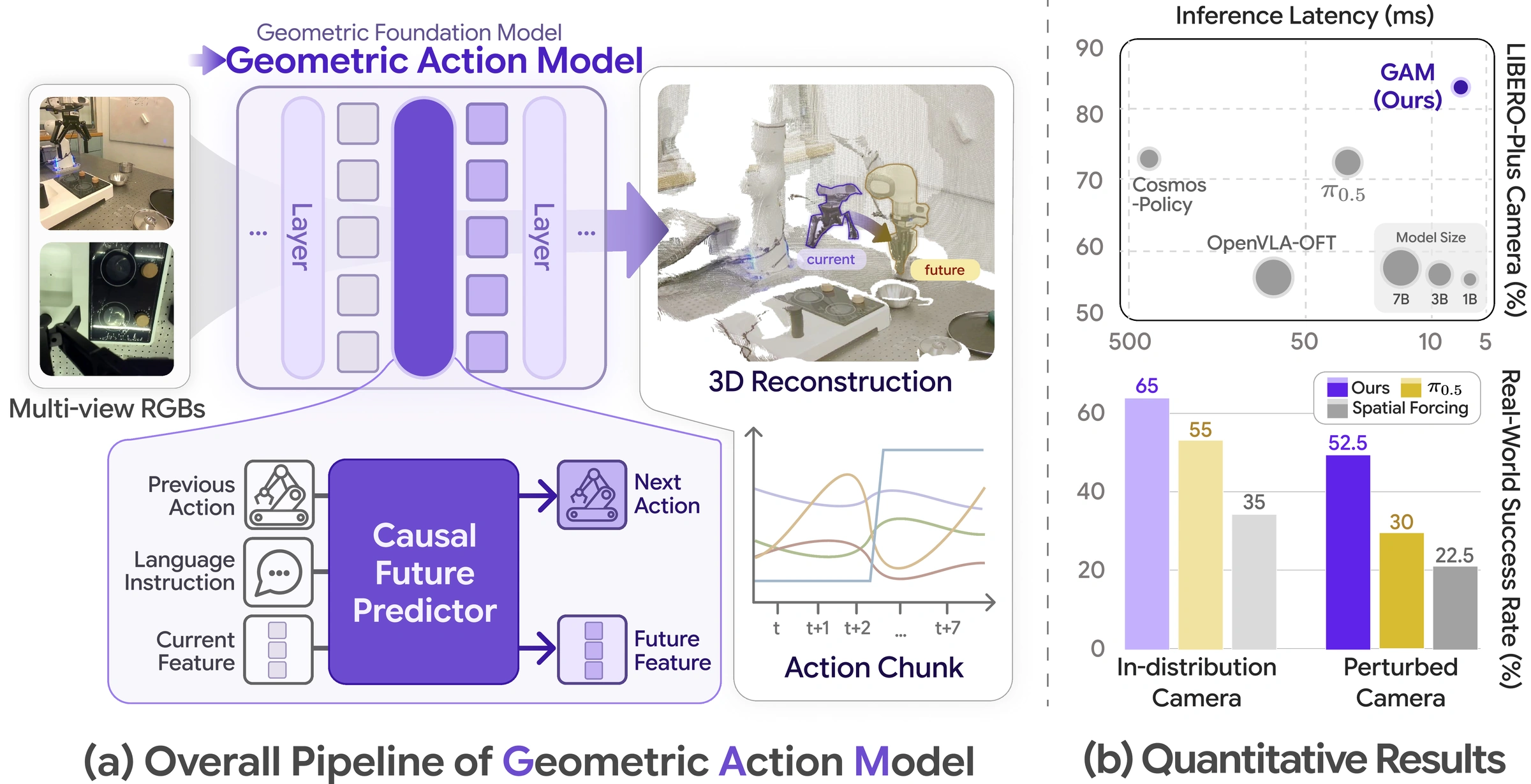
Abstract
Geometric Action Model (GAM) is a language-conditioned manipulation policy that directly reuses a pretrained geometric foundation model as the shared backbone for perception, temporal prediction, and action decoding. GAM splits the geometric model at an intermediate layer: early blocks encode observations, a causal future predictor forecasts latent tokens conditioned on language and robot state history, and the remaining blocks propagate those tokens into future geometry and actions.
Across simulation and real-robot manipulation benchmarks, GAM improves accuracy, robustness, inference speed, and model efficiency compared with foundation-model-scale baselines.
Notes
- * Equal contribution
- † Corresponding author